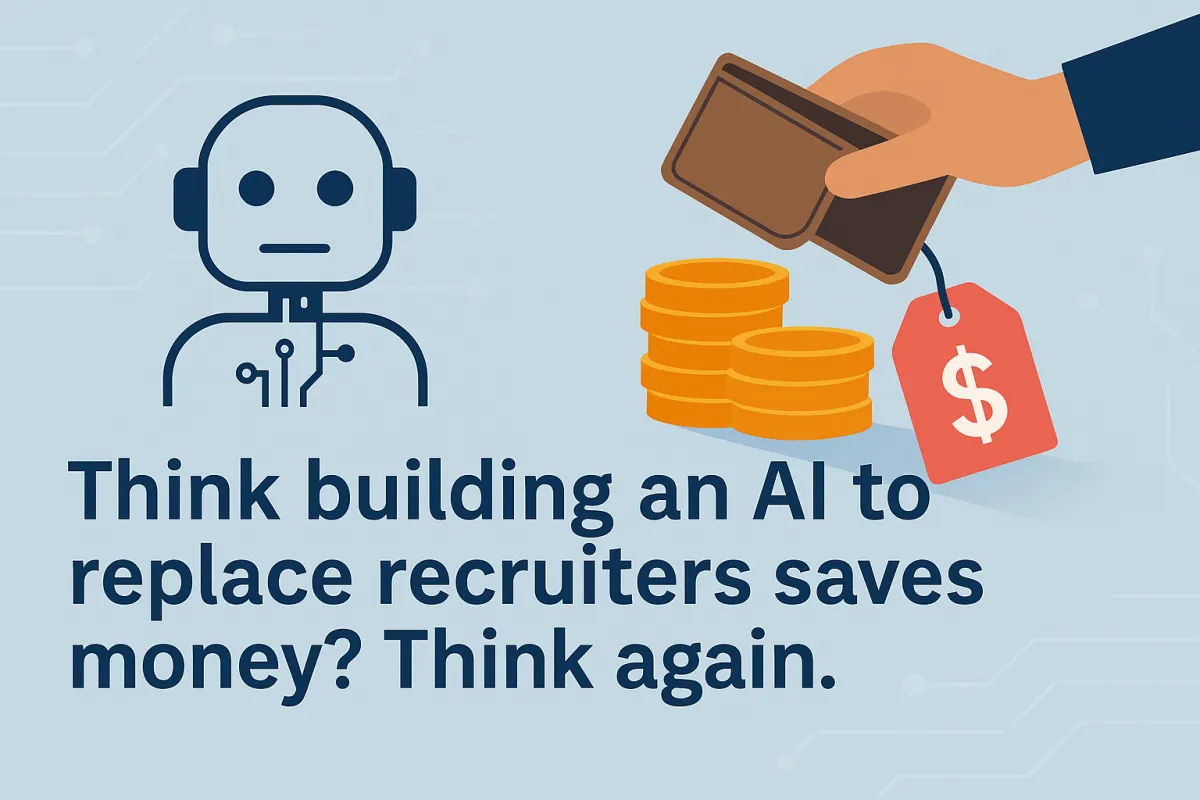
Think building an AI to replace recruiters saves money? Think again.
From a buyer’s perspective, the “build it ourselves” route looks attractive at first, but the two biggest hidden costs are: 1) training the AI to be a top recruiter and maintaining AI at genuine top‑tier recruiter standards, and 2) owning a fragile web of n8n workflows and tools that will constantly need fixing, securing, and upgrading.
1. Training AI to real recruiter standards
To reach “senior recruiter” quality, you are not just plugging in ChatGPT; you are encoding questioning styles, counter‑offer handling, objection responses, qualification frameworks, sector nuances, and compliance nuance into prompts, workflows, and examples. Independent estimates for building an advanced AI recruitment tool (even without full frontier‑model training) run in the $30,000–80,000 USD range when you factor in specialist time, data preparation, and iteration.
Typical AI‑model and workflow‑tuning projects allocate tens of thousands of dollars just to data collection, prompt design, and ongoing refinement, even before infrastructure and UX. For an internal team starting from scratch, a realistic envelope to get close to the behaviour of a highly trained human recruiter is $40,000–100,000 USD over 6–12 months, once you include senior domain experts’ time in writing examples, reviewing outputs, and tightening the system.
2. The real cost if you want to try DIY
A reasonable internal DIY plan usually means a small squad: 1–2 developers/automation engineers plus a recruiter “product owner,” running at blended day rates of $400–1,000 USD/day for 4–6 months. That alone often lands in the $30,000–120,000 USD range, before any third‑party AI/API usage or tooling subscriptions.
Industry guides for AI hiring assistants and custom AI agents routinely quote $15,000–60,000 USD for an MVP and $30,000–100,000+ USD for a robust production‑ready system. For most recruitment businesses, that is several times the cost of simply adopting a specialised product that already embodies thousands of hours of recruiter expertise.
3. Risks of n8n plus “lots of bits” of software
Stitching together many tools in n8n is powerful but fragile: small changes to one API, field name, or auth method can silently break downstream flows, causing missed candidates, duplicate outreach, or unlogged activity. Practitioners warn that DIY automations often become “maintenance nightmares” with fragile workflows, hidden security issues, and performance bottlenecks as complexity grows.
Security and data‑protection risk is real: imported workflows and community nodes can contain hidden logic, unsafe code, and credential exposure, and n8n instances need active patching and audit to avoid vulnerabilities. For a recruitment firm handling CVs and sensitive candidate data, the compliance cost and reputational risk of a misconfigured workflow can easily exceed the annual licence cost of a well‑designed, hardened product.
4. Ongoing maintenance and hidden lifetime costs
Even after a DIY build “works,” there is continuous work: updating prompts, adapting to new client processes, maintaining GDPR/CCPA alignment, rotating keys, updating APIs, and retraining staff to understand how the automations behave. AI‑model and workflow upkeep commonly runs into many thousands per year in engineering plus domain expert time.
By contrast, a mature product spreads those maintenance costs across many customers, ships improvements regularly, and bakes in security, monitoring, and best‑practice flows by default. For a typical agency, that means the annual subscription can be less than one month of internal AI/automation engineer time, while removing a large chunk of operational and compliance risk.
5. Why a packaged solution is a bargain
When buyers compare the true DIY envelope ($40,000–100,000+ USD over year one, plus ongoing maintenance and risk) with a specialist AI recruiter platform priced closer to a single recruiter’s annual fee or even less, the economic case for “buy” over “build” is compelling.
More importantly, the value is not just cost saving; it is time‑to‑impact. Instead of spending 6–12 months experimenting with AI behaviour and chasing down broken automations, they can be live in weeks on a system already tuned for recruitment excellence, with guardrails and workflows that have been battle‑tested across many roles and clients.