
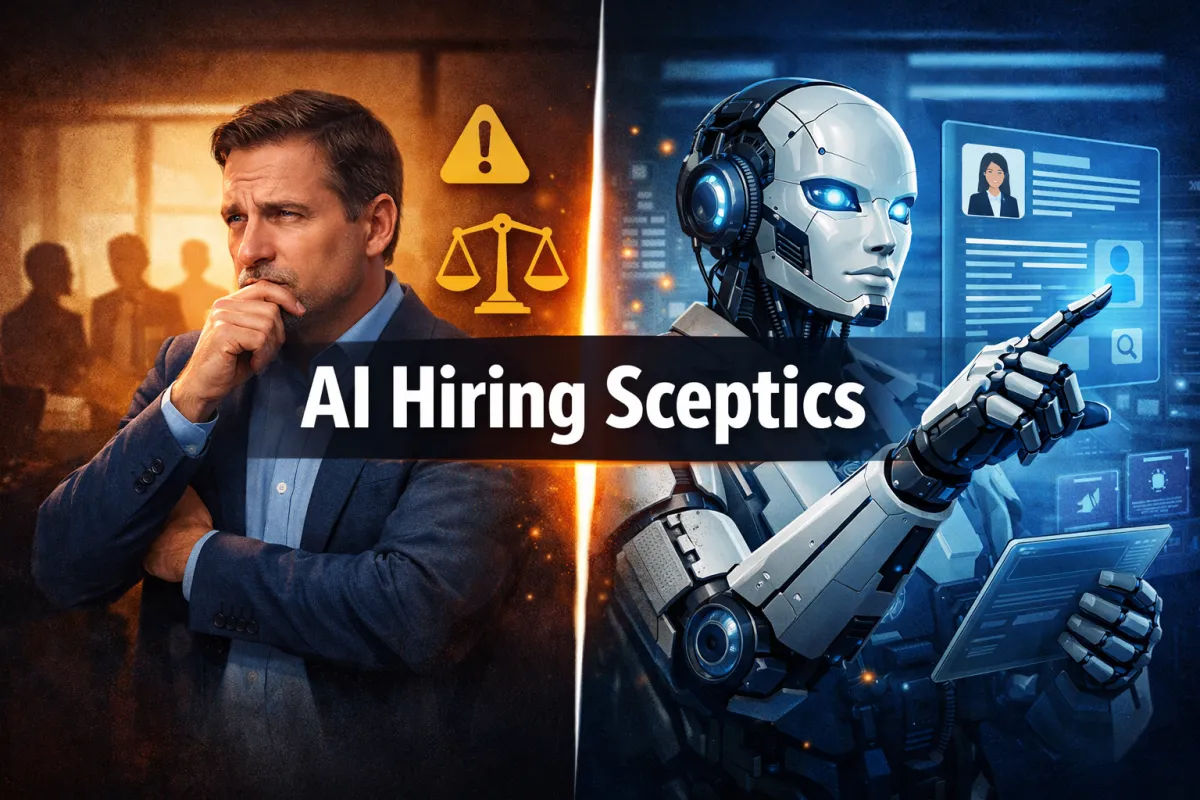
AI Hiring Sceptics
Many talent leaders are still uneasy about AI in hiring, yet nearly three-quarters now rely on it every week to keep their functions running. In 2026, the difference between teams that win talent and those that fall behind is less about headcount and more about how intelligently they deploy automation.
Why the scepticism persists
HR has always been anchored in relationships, nuance, and judgement, so the idea of an algorithm filtering people can feel like a threat to professional identity. Many leaders also worry about bias, regulatory risk, and candidate pushback, even as evidence mounts that well-designed AI can actually support fairer and more consistent decisions. On top of that, most have only encountered basic tools - CV parsers, templated chatbots, clunky scheduling apps - which makes “AI in hiring” sound like a euphemism for impersonal automation.
The real bottleneck in 2026
In most TA teams, the workweek is still dominated by low‑leverage tasks: triaging inbound applications, chasing hiring managers for feedback, manually scheduling interviews, and sending status updates. Those activities are essential but do not actually differentiate your employer brand or your quality of hire; they just keep the engine turning. Meanwhile, candidate expectations have been reset by on-demand consumer experiences: they expect rapid responses, mobile-first interactions, and clear next steps, and they quickly disengage if processes drag. The gap between what candidates expect and what stretched teams can deliver grows every quarter, especially in competitive markets.
What modern AI now does well
The new generation of SuperBiller AI recruiters goes far beyond a rules-based chatbot or a simple screening script. They can handle initial outreach, qualification, interview coordination, and ongoing candidate communication around the clock, while adapting tone and messaging to your brand and market. Instead of pushing candidates through rigid flows, conversational systems adjust questions based on each answer and background, creating tailored interview paths that feel more like a real discussion than a form fill. Large-scale experiments have already shown that AI-led interviews can increase offers, starts, and early retention without degrading candidate satisfaction, precisely because they probe consistently and never get fatigued.
At the same time, you remain in control of how far automation goes: you can keep humans in the loop for approvals, adjust automation levels by stage, and define exactly where AI should stop and hand off to a recruiter. Done well, this preserves a human, branded experience while removing the repetitive coordination work that burns people out.
How this reshapes the recruiter’s role
When screening cycles compress from days to hours, recruiters finally recover the one asset they never have enough of: time. That time can be reinvested in what humans do best: diagnosing culture fit, influencing stakeholders, designing better interview panels, and having nuanced conversations about offers, counteroffers, and long-term career moves. Rather than replacing recruiters, AI turns them into “superworkers” - professionals who can manage more requisitions with higher quality because the groundwork is handled for them. The organisations setting the pace in 2026 are those that treat AI as a strategic teammate, not a glorified admin tool.
Why understanding limits builds trust
Trust does not come from pretending AI can do everything; it comes from being explicit about what it should not do. For example, AI is powerful at pattern recognition and workflow execution, but it still requires human oversight on edge cases, value judgements, and the interpretation of complex context within a specific business. Being clear on boundaries - what is automated, what is reviewed, and where final accountability sits - reassures both candidates and hiring teams that technology is there to augment, not override, human decision-making. The winners in 2026 will not be the companies that shout the loudest about AI; they will be the ones that use it transparently, thoughtfully, and ruthlessly in service of better human decisions.